Norm design
The practice of seeing the unwritten rules that hold a problem in place.
Across very different engagements, the same thing kept turning up. NASA brought him in over a slow-moving crisis in its relationship with Congress. The State Department asked how the United States should invest in emerging democracies. The Kigali Genocide Memorial wanted to know why visitors left moved but did nothing. In each case, the obstacle that had beaten earlier attempts wasn’t the strategy, the budget, the leadership or the politics. It was a set of unwritten rules, so embedded in the organization or the field that nobody inside could see them.
Norm design is the practice of seeing those rules and designing change that works with them rather than against them. It draws on sociology, neuroscience and two decades of engagements, and it explains why most change efforts fail and how the ones that succeed actually work.
Leitner set out the field and its method in Stanford Social Innovation Review in 2026. In universities, it is part of the curriculum of the doctorate in social innovation at the University of Southern California, and he continues the work as Designer in Residence at the Institute of Design at Illinois Institute of Technology.
What he started
Insight Labs
A pro bono strategy platform. Over five years, more than six hundred scientists, artists, academics and executives worked on hard problems for governments, institutions and NGOs in fifteen cities.
See the sessions → Co-founderUX for Good
The first organization to apply experience design to social problems. Much of the early work in norm design happened here, including the redesign of the Kigali Genocide Memorial.
Visit UX for Good → USC · Innovator in ResidenceA doctorate in social innovation
Helped design the nation’s first doctorate in social innovation at the University of Southern California, with norm design as part of the curriculum.
See the program →The work
Two decades of engagements with governments, institutions, foundations and companies.
A new framework for understanding and helping families facing pediatric cancer
A new institution helping nations recover from conflict and build more peaceful societies
A new approach to reinvigorating Chicago’s downtown
The first-ever sequence for achieving the UN Sustainable Development Goals
See the findings →A new model for using professional sports to build better cities
See the report →A new funding model for nonprofit theater
See the report →A strategy for integrating art therapy into military healthcare
A model for genocide museums to turn visitors into activists
See the model →More collaborations
A new roadmap for expanding poetry’s reach and engagement
Poetry Foundation, Chicago
A new tool for integrating mindfulness into public education
Dalai Lama Center for Peace and Education and UX for Good, Vancouver
A new vision for how international organizations should work
U.S. Department of State and Community of Democracies, Charlottesville
A new path for expanding mobile healthcare
Harvard Medical School and Family Van, Boston
A new tool to improve the standard of living for professional musicians
GRAMMY Foundation, New Orleans Jazz and Heritage Foundation and UX for Good, New Orleans
A new model for U.S. investment in emerging democracies
U.S. Department of State and Carnegie Endowment for International Peace, Palm Springs
A new roadmap for the future of law firms
Law 2023, Chicago and Washington, DC
Experiments exploring new ways to energize American Jewish life
Jim Joseph Foundation, Denver and New Orleans
New insights for designing restaurants as community hubs
Panera, Boston
A new revenue-sharing model for taxi advertising
Clear Channel, Chicago
Plus collaborations with NASA, the United States Holocaust Memorial Museum, Shedd Aquarium, Starbucks, UBS, Allsteel, Lurie Children’s Hospital, Chicago Public Media, Great Books Foundation, Ashoka and others.
Speaking
Every ambitious change, inside an organization, across an industry or out in the world, runs into forces nobody talks about and most people can’t see. They decide what gets taken seriously, what quietly dies, and whether bold ideas last long enough to matter. They are the subject of Leitner’s keynotes and workshops.
Past audiences include Facebook, Microsoft, AT&T, MetLife, the U.S. General Services Administration and the International Federation of Arts Councils and Cultural Agencies, among forty others. He has spoken at Harvard, Stanford and the World Government Summit in Dubai.
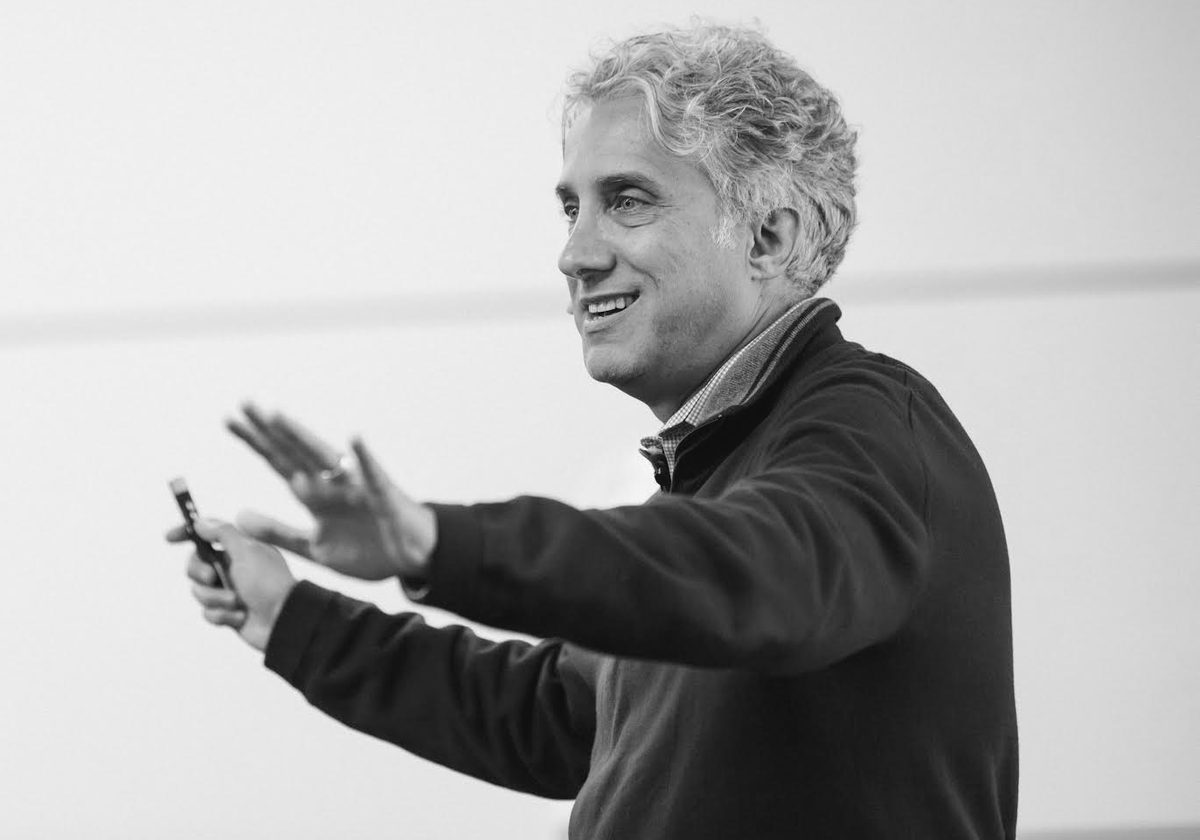
“Jeff’s talk on unwritten rules was as insightful and thought-provoking as it was entertaining and engaging.”
Esther Lee · Global CMO, MetLife